
Our fight against staffing cuts did not begin with this budget season. The cuts to staffing, security, and services proposed for the 2026 Chicago Public Library (CPL) budget are just the latest event in the ongoing trend of cuts at CPL. This history can get lost when we just think of a budget in relation to the previous year, or to the year before that. This blog post provides more context as to how we got here–a library system full of passionate and dedicated workers who are unable to provide their communities the library services they deserve due to over a decade of aggressive austerity measures.
2012: Layoffs and a Massive Staffing Reduction
In 2012, then-Mayor Rahm Emmanuel pushed for a City budget with a 26.3% cut to CPL staffing (p. 95). This staffing reduction targeted CPL’s Library Pages, whose work is often overlooked but is crucial to maintaining the daily functioning of the library. Pages shelve books and other media, put materials back in order so patrons find what they’re looking for, assist with processing of holds, and much, much more.
2018: Office of the Inspector General Staffing Audit
In 2018, the Office of the Inspector General (OIG) issued an audit analyzing CPL’s staffing strategy and implementation. The OIG found that the library’s staffing plan “… is not sufficient to align library branch staffing with community needs.” The OIG recommended that, in order to improve staffing at the library, CPL management must “include stakeholders such as library employees, as well as board and community members, in redesigning its staffing plan.” In 2017, library staff consisted of 946 Full-Time Equivalent (FTE) positions. By 2018, staffing was still below 2011’s level–the library had not recovered from Emmanuel’s cuts.
2019, May: Office of the Inspector General Staffing Audit Follow-up
In a follow-up inquiry, the Office of Inspector General noted that “in response to the audit, CPL described corrective actions it would take regarding some audit recommendations, but disagreed with OIG’s recommendation to disseminate the plan to all library employees and declined to involve CPL’s Board of Directors and community members in redesigning the plan” (p. 2). In other words: CPL and the City chose not to consider any input from library employees and community members. Patrons and staff alike continued to be left out of the City’s staffing plan for the library.
2019, June: Mayor Lori Lightfoot declares she will open all the libraries on Sundays
In the early summer of 2019, then-Mayor Lori Lightfoot announced her intent to open all 81 branch libraries on Sundays by the end of 2020. “For Chicago to thrive, we need all of our residents – especially our young people – connected to rich, engaging, and safe environments where they can be empowered to explore their passions and develop their talents.” At the time of the announcement, Lightfoot did not explain how this massive expansion of CPL’s operating hours would be funded, nor how it would be staffed.
2019, December: City of Chicago agrees to hire more staff to support Sundays
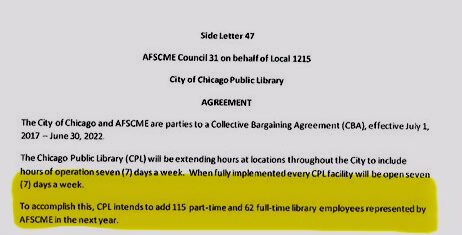
Ahead of the planned hours expansion, the City of Chicago met with the CPL Employees’ Union, AFSCME Local 1215, to discuss the need to increase staffing levels in order to provide minimally adequate coverage for Lightfoot’s proposed expansion of operating hours on Sundays. The City agreed that in order for Sundays to work, CPL would need to add “115 part-time and 62 full-time library employees represented by AFSCME in the next year.” These additional staff were never hired, and we have never reached the amount of staff we were promised by the City in order to adequately staff Sundays. The side letter documenting the City and CPL’s promise to hire, shown below, was signed by City and union representatives and codified in our contract.
2020: The COVID-19 Pandemic and foundation worker layoffs
When COVID-19 hit in early 2020, Lightfoot endangered library workers by refusing to close the libraries even after the scale of the catastrophe had become clear. All 81 CPL locations remained open until Governor Pritzker issued an executive order overriding the City and forcing library locations to close, for the sake of public safety. In June 2020, with the pandemic in full swing, CPL reopened fully to the public–months before other city agencies besides the police and fire departments. During this time, library staff aided Chicagoans without home internet access who would not otherwise have been able to access essential services (city, state, and federal) that had moved online. Staff funded by the Chicago Public Library Foundation–Cybernavigators and YOUmedia mentors–were all laid off, revealing the precariousness of using non-City, non-union employees to bolster our workplaces.
2021, February: Library staff denied early vaccine access despite doing essential work
In 2021, when the first COVID-19 vaccines became available, Chicago Public Library workers were told that while our work was essential, we were not. We were not given priority vaccine access while staff helped seniors and other vulnerable Chicagoans apply for vaccine appointments.
2021, April-December: Sunday hours expansion begins
In April 2021 the City began opening branches on Sundays. According to the Sun-Times, “the Sunday expansion was bankrolled by an $18 million property tax increase in Lightfoot’s first budget. It was supposed to come to all 77 branch libraries as fast as a hiring blitz would allow.” Despite the increase in property taxes in 2019 and 2020, which supposedly had funded CPL’s expanded operating hours with money earmarked for a “hiring blitz,” CPL and the City never received the full staffing numbers promised in Side Letter 47. The City and CPL likewise never expanded CPL locations’ security coverage.
The Sunday hours expansion moved forward despite the City’s failure to conduct promised hiring. By December, all library locations were officially open on Sundays.
2024, November: Vacancy cuts begin, staff speak out about hiring
Over the next three years, the City failed to address staffing and hiring issues dating back to at least 2018, and failed to meet the promised staffing threshold in the Sunday Hours Side Letter. In a written statement submitted to City Council ahead of the library’s budget hearing, AFSCME Local 1215 identified that “after a great deal of turnover, CPL has a headcount of 947 FTEs, with a vacancy rate around 20%. We have upheld our end of the bargain for four years, yet the City has only fulfilled about 30% of its promise to hire 119.5 FTEs.” In spite of this, Chicago’s 2025 budget cut 50 FTEs, or 78 vacant positions, from the library, demonstrating not only the City’s failure to hire and support staff, but also that they had given up on their promise to remedy staffing deficiencies.
2025, October: More budget cuts
This brings us to the current budget season, during which Mayor Brandon Johnson has proposed cutting 89 more vacant positions from the library and slashing our collections and security budgets in half.
Conclusion
The Chicago Public Library (CPL) system has not been properly staffed for over a decade. Five years ago the City made a promise to rectify our staffing issues in order to expand services, and that promise was never fulfilled. The vacancy cuts proposed for 2026 will further expand and codify CPL’s longstanding staffing deficiencies.
During this budget fight, CPL and the City have insisted that even if they make these cuts we will be able to maintain “core services.” However, they have not been honest about their definition of that term. To management, “core services” simply means keeping the lights on and the doors open. Library workers know better.
For the past five years, we have cut programs, canceled outreach, left reference desks empty and faced the impossibility of answering every ask for help we receive each day, because we do not have enough staff to provide all of these core services. Cutting library vacancies IS cutting library services. We want to provide the resources that our communities deserve, but we cannot do so until the City upholds its promise to properly staff the library.